- Bowen's Newsletter
- Posts
- BNT: Weekly Wellness #031
BNT: Weekly Wellness #031
Weight fluctuation and why it's not your fault.

Bowen Naylor
January 12, 2026
Weight Fluctuation
It’s the beginning of the year, motivation is high, and goals are fresh.
One of the most common New Year’s resolutions?
“I want to lose weight.”
That’s a great goal… and a challenging one.
And like any challenging goal, there will be bumps in the road. One of the biggest reasons people fall off track isn’t food… it’s the scale.
There’s nothing more frustrating, heartbreaking, and straight-up demoralizing than waking up, stepping on the scale, and seeing your weight up 1, 2, or even 3 pounds from the day before. Especially when you ate perfectly.
I’m here to tell you that is completely normal.
It’s called weight fluctuation.
We want weight loss to look like a straight-line trending down, but it doesn’t. It never has. And it never will.
Sometimes the scale goes up even when you do everything right. That’s because body weight is influenced by far more than fat alone, including:
Salt intake
Stress levels
Where you are in your cycle
What time you ate
How much water you drank
Whether you’ve used the bathroom
What time you weighed in
None of these mean you gained fat.
My Recent Story
One year I lost 30 pounds.
I counted my calories, I counted my protein, and I even tracked my water…
Checkout a graph of my weight loss journey:
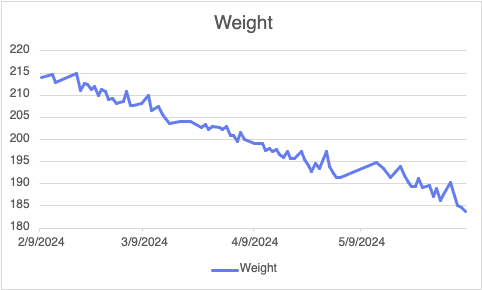
You’d expect a nice downward line… but that’s not what it looked like.
After two weeks, I actually weighed more than when I started.
That was frustrating.
But here’s the key lesson I had to learn the hard way:
Weight loss is not linear.
So, what did I change after week two?
Nothing.
I knew I was already in a calorie deficit. I trusted the process. And slowly, over time, the weight began to fall off. And it kept falling.
Over those 16 weeks, my weight went up and down constantly. It was scary in the moment, but when I zoomed out, the trend was clear:
Downward.
Examine the Facts
You cannot attach your emotions to the scale.
It will crush you.
If I had attached my emotions to the scale, I would’ve quit after week two and told everyone my body was “different” or “broken.”
Instead, talk to yourself the way you’d talk to a friend.
If a friend told you they gained one pound overnight, you’d probably laugh. You’d know that it isn’t fat. You cannot gain one pound of fat overnight. One pound can be the difference between eating dinner at 6:00 vs. 8:00.
You’d tell them to relax and stick to the plan.
(At least I hope you would—after reading this 😉)
When the scale goes up, ask yourself these 5 questions.
Did I eat more salt yesterday?
Did I eat at different times than usual?
Is my bathroom schedule off?
Have I been more stressed lately?
Did I have a hard workout recently?
Any one of these can cause the scale to jump. Without any fat gain.
Another Explanation (for the ladies only)
Women often experience larger weight fluctuations due to their menstrual cycle. It’s not uncommon to see the scale change 3–5 pounds in just a few days.
While that can be discouraging, it’s important to remember:
This is mostly water weight. Not fat.
A helpful strategy is comparing your weight to the same phase of previous cycles instead of day-to-day numbers.
The Hard Truth
You’re not going to lose weight every day.
Or every week.
Sometimes, you may even gain weight.
Most people don’t quit after a drop on the scale. They quit when their weight plateaus or goes up.
Don’t let that be you.
This isn’t fat gain.
This is water retention.
Stick to the plan. Trust the process. Zoom out.
Progress is happening. Even when the scale says otherwise. 💪📉
Want to hear this from someone smarter than me?
Watch this video by Jordan Syatt. He’s a famous personal trainer who gives a great explanation of weight fluctuation.
Learn about my January Protein Challenge in this newsletter!
Thanks for the read! If you enjoyed what you read share this link with a friend!